
When utility companies deploy temporary power systems, mobile substations, or emergency backup infrastructure, the cable used in the process is only part of the equation. And the way those cables are transported, stored, deployed, and protected in the field can have a major impact on both operator safety and system reliability.
For utilities working with medium voltage cable, the stakes are especially high.
“With medium voltage cable, a lot of times we talk about how if you make a mistake, you get a blowout,” said Jay Hathaway, Director of Vertical Market Development for Amphenol PPC Wire & Cable. “And sometimes that's really, really bad. So we want to make sure we can avoid that at all costs.”
As utility providers continue investing in grid resiliency, mobile substations, temporary power infrastructure, and emergency preparedness, cable deployment systems in the form of substation recovery trailers are becoming a critical part of safe operations.
The Challenge of Moving Medium Voltage Cable
Anyone working in utilities can attest to one universal truth: medium voltage cable deployments are physically demanding. And the environmental conditions? Often difficult. Crews may be deploying cable during storms, outages, or emergency situations where speed matters.
“On these deployments, you’re going to be using big, heavy cables,” Hathaway explained. “We don't want to get people hurt, and we want to make sure that they can manage those cables in a way that's easy and makes sense for them. Especially because emergencies don’t always happen at two in the afternoon on a sunny day. Sometimes those crews are out there at three in the morning in the rain."
Though most studies on shift work have been conducted in the medical industry, findings largely conclude that on-call and shift workers tend to have a higher risk of occupational injury.
With the risk of injury and potentially inclement weather conditions, deployment equipment needs to do more than just transport cable. It must reduce strain on operators, prevent cable damage, improve deployment speed, and minimize the risk of failure.
And before we can even dive into the deployment equipment and how it can help reduce risk of injury, it's important to look at one of the primary sources of strain and physical exertion: the cables themselves.

Why Cable Flexibility Matters
Not all medium voltage cables are designed for mobile deployment applications. In fact, many traditional designs are downright challenging to use in mobile situations. Hathaway compared traditional MV-105 cable designs to being like a baseball bat. "It's just not a very user-friendly product."
For mobile substations and temporary installations, flexible cable designs offer major operational advantages.
"With type SH cable, what you'll see is the center conductor is finely stranded, and you've got your semi-conductive, braid shield, and insulation materials designed to allow the cable layers there to allow that to flex, move, and bend," he explained.
That flexibility helps crews maneuver cable safely in the field while reducing stress on both the cable and the operator. And maneuvering cable truly is a stressful experience... During NRECA's 2026 Safety Leadership Summit in St. Louis, one individual stopped by the ATPC booth to talk about how stiffer cable snapped back in the field and — just like that baseball bat allusion Hathaway drew — hit him in the mouth. The result for that individual was a broken tooth and swollen lip. Ouch!
"When human operators are using it, that's where safety becomes really important," Hathaway said. "And flexibility truly does give you a great advantage. With SH cable, they can maneuver this around easily and get it into whatever areas that they need to."
Flexible shielding systems can also help improve handling. Hathaway noted that braided shields add significantly more flexibility than traditional copper tape shields in portable applications.
Designing Deployment Systems Around Safety
According to Hathaway, safe deployment begins with understanding how utilities actually use cable in the field.
"We want to work with the utility company to make sure that we understand your cables, understand the size that you use, the lengths that you use, the lugs that you use, and make sure it's all sized properly for what you're going to need."
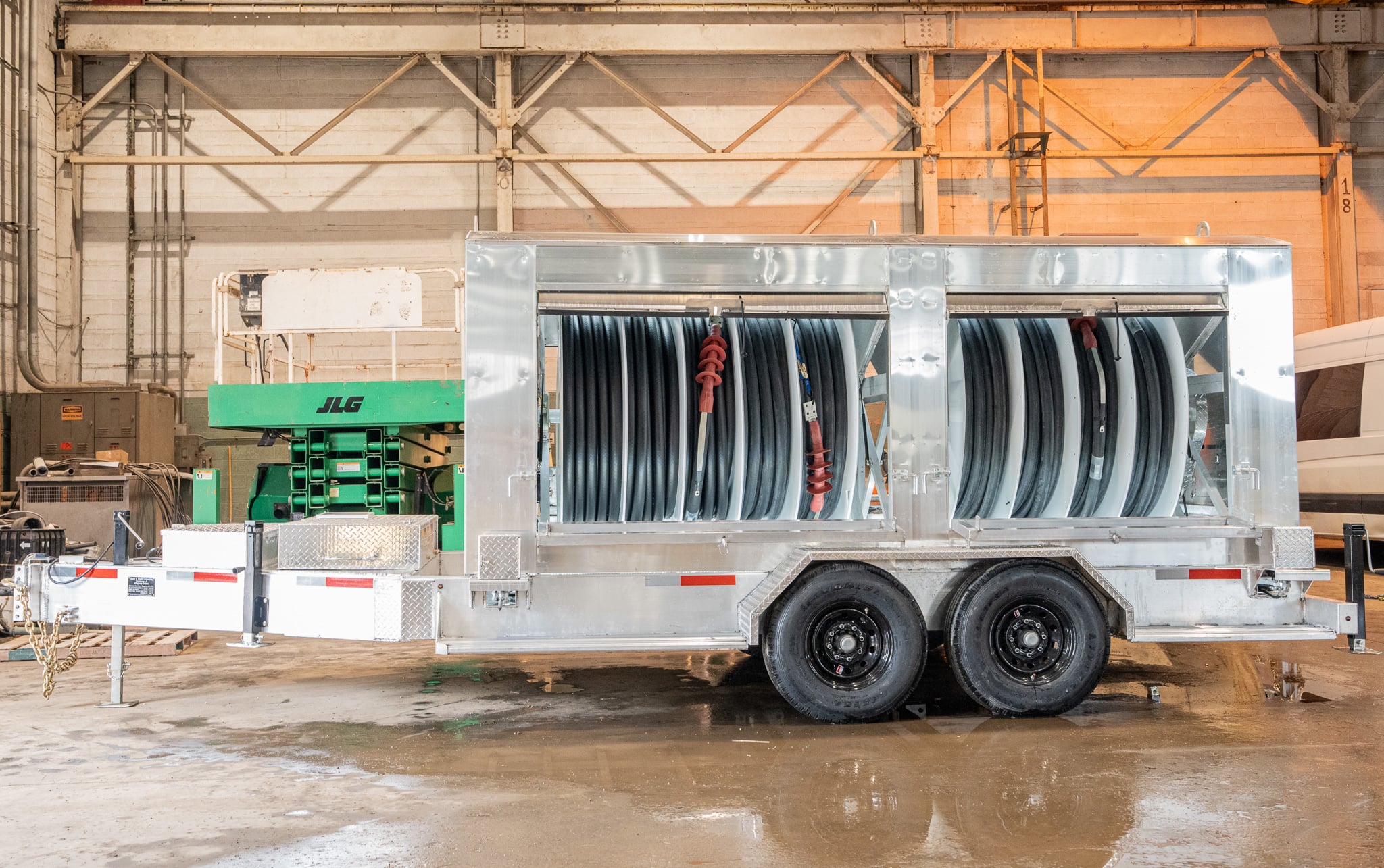
That customization carries into trailer and cable reel system design, where only ATPC can deliver a complete, ready-to-go cable deployment solution complete with the cut, connectorized, and ready-to-deploy cable you need.
ATPC takes a true one-stop-shop approach to medium voltage cable deployment, helping utilities eliminate the complexity of coordinating multiple vendors. We carry a deep inventory of Type SH medium voltage cable, cut each length to your exact specifications, and install the terminations of your choice before delivery. To ensure performance and safety, we also provide electrical test reports validating the integrity of every medium voltage termination. Beyond the cable itself, our team designs custom reeling and deployment systems so utilities can store, transport, and deploy their cables safely and efficiently in the field. The result is a fully integrated substation recovery trailer that arrives ready for immediate use.
"So we've got a lot of things that we want to look at when we design a trailer," Hathaway said. "These are highly custom solutions. We'll look at everything you might need — we really want to make sure that the cables aren't going to rub and get the jackets damaged as they're coming off the trailer."
While other trailer manufacturers will check boxes on a spec sheet to deliver a standard solution, the experts at ATPC engineer beyond the spec sheet for real-world performance, ensuring the solution itself won't wear on the longevity of the cables. As a result, our cable deployment trailers often incorporate:
- Roller bars to reduce jacket abrasion
- Gas over hydraulic or electric cable reel systems
- Adjustable payout speed controls
- Connector protection systems
- Rotating reel platforms
- Interchangeable reel designs
- Emergency freewheel release systems
These features are designed to reduce manual handling while improving deployment efficiency.
"These all make it very simple for an operator to come in and get the job done quickly," Hathaway said. "You can really deploy the cables with just a few people."
Which is, of course, a significant improvement over fully manual deployments.
"I know we've seen guys come in with manual deployment scenarios and they'll basically pick the cables up on their shoulder and just walk it in assembly line style," he said. "You've got 25 guys loading in one cable, and they're lifting this heavy, stiff solution on their shoulder in conditions that are less than ideal. It's simply not the safest way to handle deployment or retrieval of heavy power cables."
In that respect, these features become safety controls. By minimizing manual handling and improving control, utility providers can reduce operator fatigue, lower the risk of injury, and prevent dangerous failures in the field.
These features also serve to protect and extend the integrity of the permanent grid into mobile applications, enabling utilities to restore power faster, adapt to changing conditions, and maintain continuity of service during outages or planned upgrades. This makes well-engineered cable reel trailers a critical link in the broader grid resiliency strategy, as mobile substations and mobile transformer systems do not operate in isolation — they are deployed to temporarily tie into existing grid infrastructure like transmission lines, distribution feeders, substations, and critical load centers. In these situations, cable reel trailers serve as the physical and operational bridge between mobile assets and the permanent grid. Proper reel design, controlled payout, termination protection, and cable management ensure that these temporary connections perform reliably.
Preventing Damage During Deployment
Protecting cable assemblies during transport and payout is another major concern for utility companies, as it should be — cable is a major investment, and storage solutions that lack controlled tension, bend radius protection, and other protective measures may degrade the cable's service life.
"One of the things we'll do on the cable reel is a cut-out pocket on the inside, so when that insulator shed goes inside that reel, it ties into the reel and is protected," Hathaway explained.
The goal of this feature is to protect sensitive terminations and prevent damage during repeated deployments. As anyone who has ever worked with medium voltage cable deployment knows, those sheds are relatively delicate, and they often stick out.
"And it's a nice way to protect the cable connectors," Hathaway said. "But it also has a practical use, too — when you have to use them again, they're easily accessible and ready to go."
Of course, the terminations aren't the only things that can be damaged during transport and use. When it comes to in-field use in particular, speed control is another important safety feature.
"We really want to make sure that the cable reel doesn't spin like a top," Hathaway said. "Because if it's going too fast, it can hurt operators."
And injuries aren't wholly uncommon among utility workers. Circa 2,400 for every 100,000 linemen will face serious injuries each year. Of those impacted by the dangers of the job, around 42 individuals lose their lives each year. And storm recovery work is especially dangerous — with less-than-ideal weather conditions and unpredictable hours, linemen are often exhausted, which can lead to mistakes.
To help lessen the likelihood of speed-related mishaps, ATPC deployment systems often include flow control valves and braking systems to regulate reel payout speed.
Lessons From Emergency Preparedness
In any industry, it's not uncommon to hear that "regulations are written in blood." This essentially means that safety rules and regulations are often born from real-world incidents, and fortunately, the information age has made it easier than ever to share information about incidents and improvements.
And just 15 years ago now, one major incident highlighted the importance of deployment-ready infrastructure: the Fukushima nuclear disaster. Fortunately, this incident didn't result in any fatal injuries, but it did make the world pause and take note of the importance of emergency preparedness.
Following the event, the U.S. nuclear industry developed emergency response programs focused on ensuring backup equipment, generators, and cables could be rapidly deployed during a crisis.
"So what the U.S. nuclear agency said is, 'how do we never let that happen on U.S. soil?'" Hathaway explained.
That effort led to specialized trailer systems, storage facilities, and portable deployment solutions designed to move large volumes of cable quickly and safely.
For many utilities, those same principles now apply far beyond nuclear applications. Grid resiliency programs, mobile substations, mobile STATCOM systems, and emergency restoration projects all require fast, reliable cable deployment capabilities.
Reducing Risk and Operational Costs
Improvements are not only about protecting equipment; they also help utilities reduce injuries and operational costs.
"We often talk about how if we avoid just one OSHA recordable event, we can actually pay for two or three of these things," Hathaway said.
And OSHA penalties are no small matter. Violation penalties alone can range from $16,550 to $165,514, and that's excluding indirect costs like lost production hours, equipment repair or replacement, and legal expenses.
Cost-saving safety improvements have become increasingly important as utilities face labor shortages, aging infrastructure, and rising demands for rapid outage response.
"We just want to make sure we can avoid any types of these costs by providing a system that allows operators to use the product safely."
Building Systems for Real-World Conditions
Ultimately, deployment systems must work in real-world environments, not just in controlled conditions, as utilities may need to move cables across rough terrain, deploy them during severe weather, or operate in locations where power is unavailable.
That is why many systems now include:
- Gas, diesel, electric, or hydraulic drive options
- Forklift-compatible transport systems
- Crane and helicopter lift capability
- Interchangeable reel stands
- Manual override functionality during power loss
"If you do lose power in the field, you want to make sure you get the cable off," Hathaway said. "We can unlock this from the hydraulic system, allowing the cables to get off for emergency use."
For utilities investing in resiliency and emergency preparedness, safer cable deployment is becoming just as important as the cable itself.
If you are supporting mobile substations, storm restoration, temporary power systems, or grid resiliency initiatives, ATPC can help design a new deployment solution for your site-specific cable, equipment, and operating environment.
ATPC’s engineering team can also evaluate your existing cable and deployment methods to identify opportunities to improve safety, reduce cable damage, and streamline field operations. We’re happy to discuss your application and explore a trailer solution to meet your site-specific requirements – simply request a no-obligation quote to chat with an expert from ATPC.


