
Facilities across the world are increasingly investing in variable frequency drives (VFDs). And why wouldn’t they invest in something that can improve efficiency, control, and overall system performance while also reducing energy consumption? It’s a no-brainer for many savvy plants, factories, and production facilities. But there is one issue with this change, however... As many plants invest in VFD technology, one critical component is often overlooked in that harsher environment: the cable connecting the drive to the motor.
That cable is sometimes treated as little more than a way to move power from Point A to Point B, but in reality, the cable becomes part of the VFD system itself, and perhaps the most essential element in the system when it comes to reducing downtime.
Why is that cable so important? It’s because using a standard commodity cable with a VFD system can introduce performance issues and ultimately lead to costly downtime. The rapid switching inherent to VFD operation can create transients, harmonics, electrical interference, and reflected waves that a general-purpose power cable may not be equipped to manage. But selecting a cable designed specifically for VFD applications can help improve reliability, protect equipment, and prevent avoidable failures.
According to Tim Hannigan, Senior Product Engineer at Amphenol TPC Wire & Cable (ATPC), selecting the right cable really can make all the difference.
“There are a lot of things going on in a VFD application that you don't see in a standard AC system,” Hannigan said. “From transients to interference and harmonics, a standard cable isn't necessarily designed to manage those or protect the drive system from the effects they can create.”
Understanding the difference between VFD and general-purpose cables can help maintenance and purchasing teams make a decision that goes beyond the initial price of a cable… and potentially avoid the much higher cost of equipment failure and unplanned downtime.
The Hidden Risks of Using Commodity Cable
Many facilities continue using general-purpose power cables with VFD systems because they work… Initially, at least. But the long-term consequences can be significant. In many cases, the “general purpose” cable being used is exactly what it sounds like: a conventional power cable designed to deliver electricity to a motor. And sometimes, commercially available “VFD cables” may use PVC insulation and a PVC jacket without the shielding and specialized conductor insulation required for a VFD environment… An offering that goes back to the early days of VFD technology.
“When VFDs were first being developed, a lot of THHN-type cables were used because they were already in the marketplace,” Hannigan explained. “And you’ll sometimes still find THHN-type cables being used in VFD applications. But those materials have a much higher dielectric constant, and they weren't necessarily optimized for the electrical behavior in a VFD system. That became a problem. The motors were expensive, and all that additional protection drove up the cost of the motor system.”
As the industry learned more about how VFD-generated electrical stresses move through a system, cable construction became part of the solution. And nowadays, you can find cables from companies like Amphenol TPC that are designed to withstand the unique electrical behavior that occurs in a VFD environment.
What exactly is that unique electrical behavior? Well, VFD systems naturally generate high-frequency switching, which creates electrical noise, voltage spikes, and reflected-wave phenomena. And these electrical stresses don't just affect one component. Over time, they can impact the motor, drive, cable insulation, and other parts of the system, increasing the likelihood of maintenance issues and unexpected failures.
Capacitance is one type of electrical stressor that highlights why a VFD cable’s insulation design is so important: as electrical energy travels through a conductor, some of it interacts with the surrounding insulation. Higher-capacitance insulations can store a greater amount of energy, while lower-capacitance materials can help move power more efficiently through the system and reduce the electrical burden on the motor.
“You want that power delivery to be as quick and efficient as possible down to the motor,” Hannigan said. “Materials that contribute to a lower capacitance value are beneficial in that environment.”
That is one reason ATPC uses materials such as XLPE (for smaller conductors) and EPR (for larger gauges where flexibility is as important as electrical performance) in VFD constructions. XLPE typically has a dielectric constant around 2.3, Hannigan explains, while EPR is generally around 2.8 to 3. By comparison, PVC can have a dielectric constant around 4, and PVC combined with a nylon overcoat can be even higher. Those differences may seem small, but they can have a meaningful impact on electrical performance and long-term system reliability in VFD applications.
These nuances really reinforce the importance of cable design for VFD applications, because electrical stresses can eventually make their way beyond the cable itself. One of the more common issues caused by inadequate materials is motor bearing damage caused by stray shaft voltages. As electrical current passes through the bearings, it can create pitting, frosting, and fluting on the bearing surfaces. If left unchecked, this damage can lead to increased vibration, excessive noise, and motor failure.
And the motor isn’t the only equipment at risk. If the system isn't properly grounded, electrical current can flow through other connected equipment, including gear reducers. Over time, microscopic electrical arcs can pit and scar bearing surfaces, degrading their performance and eventually contributing to equipment failure.
Cable insulation can also show signs of deterioration before a failure occurs. Corona discharge, often caused by repeated voltage stress, can gradually break down insulation and leave behind a visible signature like fluting, pitting, or frosting on bearing surfaces or white residue and discoloration on cable jacketing.
“The voltage rating on the cable doesn't tell the whole story,” Hannigan said. “A VFD cable may be rated 600 volts, but the system can generate transient voltage spikes significantly above that. That’s why you need insulation materials that can handle those conditions and resist corona inception.”
Signs of insulation degradation can take different forms, including corona discharge and partial discharge, which can leave a visible residue on the impacted cable. While they occur in different environments, both can indicate that electrical stress is exceeding what the insulation was designed to handle.
“When you get that charge buildup, it has to go somewhere,” Hannigan said. “It's going to find the quickest path to the ground. If the insulation can't manage that stress, eventually you can have a breakdown through the insulation.”
For maintenance teams, that's where the real concern begins. These issues often develop gradually, making them easy to overlook until they result in an unexpected shutdown.
And once these small electrical problems begin damaging components, the consequences can become expensive quickly.
According to Hannigan, industry experience has shown that motors in improperly designed VFD systems may need replacement in as little as six to eight months. A properly designed system complete with VFD cables, by contrast, can operate for years with a lower risk of failure and maintenance.
“It’s really simple – if you don’t use the right cables, you're going to have a problem,” Hannigan said. “It could be six to eight months out, but it's going to happen. When you put the right cable in and match the system properly, it could last for years without a problem or downtime.”
That’s why, for discerning maintenance teams, cable selection becomes a reliability decision, not just a purchasing decision.
Built for Demanding Industrial Environments
While using standard PVC power cable with a VFD-driven motor can cause issues, using quality, purpose-built VFD cable does more than simply withstand electrical stress. It’s designed to help reduce the conditions that often lead to maintenance problems and downtime. And that design goes beyond considering dielectric constants.
A commodity power cable might consist of three or four conductors surrounded by PVC insulation and a PVC jacket, with no shield specifically designed to address VFD-generated electrical noise. A purpose-built VFD cable takes a different approach. The conductor insulation is selected with the electrical characteristics of the VFD system in mind, while shielding and grounding are incorporated to help manage high frequency switching, EMI, and RFI interference.
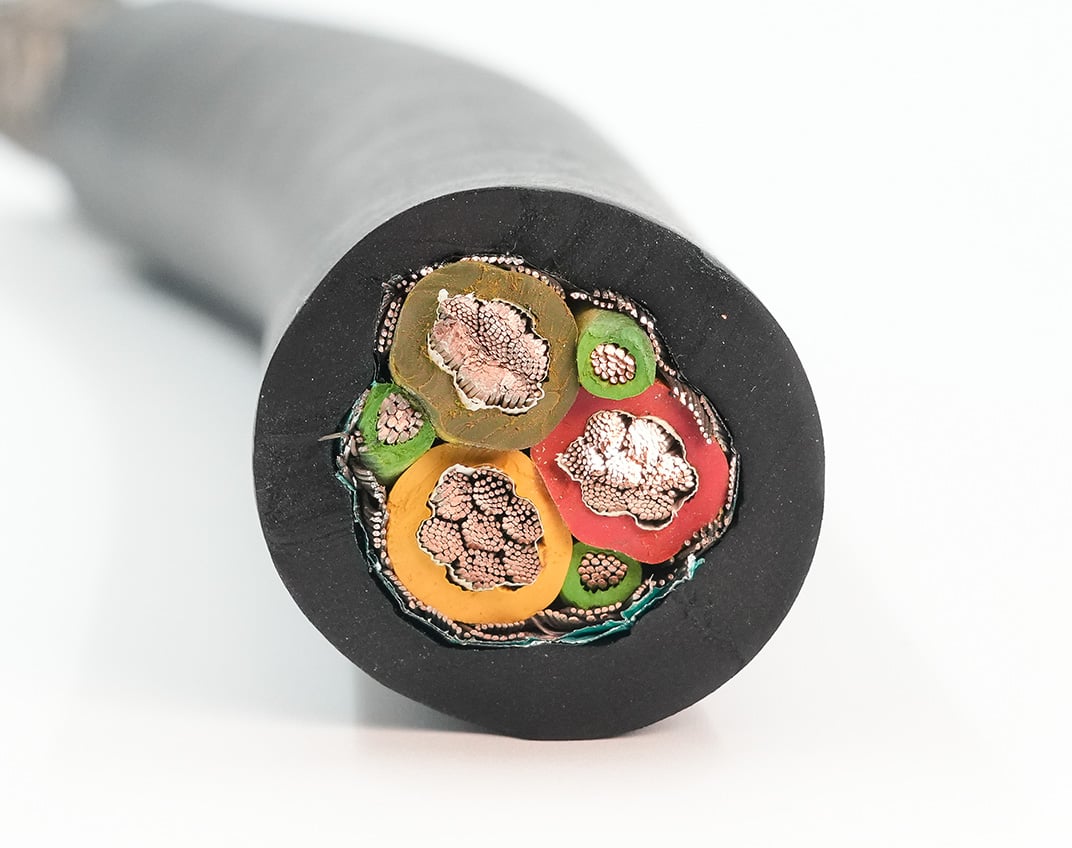
And cable construction continues to evolve. ATPC's newest VFD cable designs incorporate symmetrical grounds, distributing the grounding path around the cable rather than concentrating it in a single conductor.
Consider a conventional four-conductor cable: three conductors carry power, and the fourth serves as the ground. With the ground positioned on one side, the system is electrically unbalanced. Think of it as weight distributed unevenly around a wheel: the system still works, but it isn't operating in the most balanced way possible.
Meanwhile, ATPC's symmetrical-ground construction instead distributes ground conductors around the power conductors, creating multiple paths to ground. The three symmetrically positioned ground conductors help cancel induced currents, which reduces the potential for motor and equipment damage while also improving overall system performance,” Hannigan adds.
At ATPC, VFD cable is also engineered to survive the harsh environments found throughout heavy industry, especially abuses like flexing, extreme temperatures, and exposure to oils, coolants, and chemicals. While the insulation and shielding address the electrical environment, the jacket and overall cable construction address the mechanical and environmental environment. Both are important because downtime isn't caused only by electrical failures. Physical damage, chemical exposure, and temperature extremes truly can be just as disruptive if the cable isn't designed for those conditions.
Matching the Right Cable to the Application
Different operating environments demand different performance characteristics. Once the electrical requirements are addressed, the next step is matching the cable to the realities of the operating environment. For example:
- Super-Trex® VFD Shielded Cable delivers excellent abrasion resistance with its heavy-duty thermoset jacket.
- Trex-Onics® VFD cables offer multiple shielding configurations, including brake and signal pairs for specialized installations.
- Thermo-Trex® VFD cable is designed for higher-temperature applications that require additional thermal performance.
That’s why it isn’t as simple as replacing every commodity cable with the same VFD cable. It's important to match the cable’s construction to the electrical, mechanical, and environmental demands of its application. A facility dealing with severe abrasion has different priorities than one dealing with high temperatures. A high-flex installation has different mechanical requirements than a stationary motor application. And a VFD system with significant EMI concerns requires different electrical considerations than a basic power circuit.
Most downtime doesn't begin with a sudden breakdown. It starts with small, often invisible issues that build over time: electrical noise, insulation degradation, bearing damage, and premature cable wear. By the time equipment fails, the warning signs were often present long before the shutdown occurred.
Those problems can also create a much larger cost than the cable itself. When a motor fails, the cost isn't limited to the replacement motor. Maintenance teams may also be paying for bearings, peripheral equipment, troubleshooting, replacement labor, and lost production. That's why cable selection should be evaluated as part of the system's total cost of ownership rather than simply as an upfront material cost.
As the discussion around VFD-related failures demonstrates, selecting the right cable from the start can have a significant impact on system reliability. Rather than forcing customers into a one-size-fits-all solution, ATPC partners with users to understand their application and recommend the cable construction best suited for the demands of the installation. Facilities interested in learning more about VFD and motion-control cable solutions can explore ATPC's Motion Control portfolio for additional product information and application guidance.
Ultimately, engineered VFD cable systems are about more than power delivery. They're about extending equipment life, reducing maintenance headaches, and minimizing costly production interruptions. When the cable is treated as a critical part of the VFD system rather than an afterthought, facilities are better positioned to keep operations running reliably today and avoid unplanned downtime tomorrow.


