
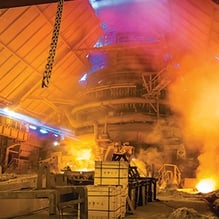
Continuous-flex applications in steel plants create some of the most punishing operating conditions for industrial cable. Cranes and transfer carts that repeatedly reel and unreel cable subject it to constant flexing, abrasion, and tension — conditions that cause ordinary cable to fail internally before visible jacket damage appears.
One steel manufacturer in India faced this problem on two separate pieces of equipment. After replacing its existing cable with engineered reeling cable from Amphenol ATPC Wire & Cable, the plant conducted an internal cost analysis to measure the operational impact.
Application 1: Overhead Crane Lifting Steel Coils
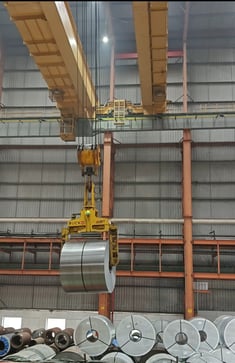 In the first application, the plant used overhead cranes to lift heavy steel coils from a transfer trolley cart to the production floor. Each lift cycle forced the crane cable to reel in and out repeatedly, exposing it to continuous flexing that caused internal conductor fatigue and breakage. The result was frequent failure: the cable lasted roughly 40 days, and each replacement required about four hours of downtime and a four-person crew.
Over 24 months, that failure pattern led to 16 cable replacements, an estimated $4,072 in combined material and labor costs, and 64 hours of production downtime.
The plant replaced the existing cable with Super-Trex® Multi-Conductor P&R Cable, engineered specifically for payout-and-retractile reeling duty. Its finely stranded tinned copper conductors are designed to improve flex-life, while the live-flex XLPE insulation system and dual-layer security-yellow TSE jacket reinforced with nylon braid help resist tearing, abrasion, and impact. Over the same 24-month period, the cable required an estimated three replacements instead of 16, reducing total cost to an estimated $1,851 and downtime to 12 hours.
Estimated result: approximately $2,221 in cost avoidance and 52 hours of production time recovered over 24 months.
Application 2: Transfer Trolley Cart
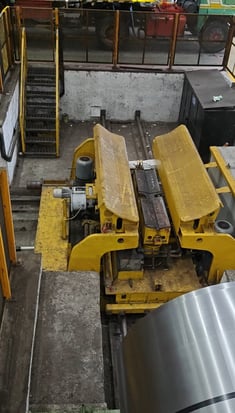 In the second application, the plant used a transfer trolley cart to move steel coils across the production floor. The failure mode was the same: with every transfer cycle, the cable reeled and unreeled repeatedly, creating continuous flexing that led to premature conductor failure. In this application, the problem was even more severe, with the previous cable failing every 30 to 35 days. Each replacement again required roughly four hours of downtime and a four-person crew.
Over 12 months, that pattern resulted in eight replacements, an estimated $4,544 in cost, and 32 hours of downtime.
The plant replaced the existing cable with Super-Trex® Triple-Gard™ Yellow Portable Cord, rated for extra-hard usage (Type SOOW, 600V). Its rayon-reinforced integral-fill construction is designed to resist corkscrewing and premature conductor failure, while the reinforced security-yellow TSE jacket helps protect against abrasion, impact, and chemical exposure. At last check, the plant had not needed to replace the cable in eight months.
Estimated result: Approximately $3,896 in cost avoidance and 28 hours of production time recovered over 12 months.
The Pattern Behind Both Results
These two applications involved different pieces of equipment, but the root cause was the same: the cable, not engineered for continuous reeling and flexing duty, was failing under repeated mechanical stress. This is a common pattern in steel, metals, and heavy manufacturing environments, where cranes, hoists, transfer carts, and other reeling equipment can expose ordinary cable to premature failure.
That is precisely why payout-and-retractable (P&R) cable designs and extra-hard-usage portable cords are used in these applications. When a cable fails faster than expected, the solution is rarely a heavier version of the same product. The correct solution is a cable engineered for the actual duty cycle.
If your operation is experiencing the same pattern, reach out to our team to review the application.
Conclusion: Do Not Buy Cable. Buy Continuity.
This case shows that the lowest purchase price does not produce the lowest operating cost. When cable is selected for the application's real conditions, the result can be fewer replacements, less downtime, and lower total cost over time.
For this plant, Super-Trex® solutions turned repeated cable failure into a measurable operational improvement. If wiring failures are increasing costs at your facility, now is the time to evaluate the duty cycle, the environment, and the cable design behind the problem.


